Our Latest Safety Data on Operating Motor Vehicles
Millions of workers drive or ride in motor vehicles as a crucial part of their jobs. Whether they drive light or heavy vehicles or if driving is a main or incidental job duty, these workers are at risk. Motor vehicle accidents are the leading cause of work-related deaths in the United States.1
Let’s look at which industries report the highest percentage of motor vehicle accident claims and recommended tips on how to avoid these accidents.
Industry leaders in motor vehicle accident claims
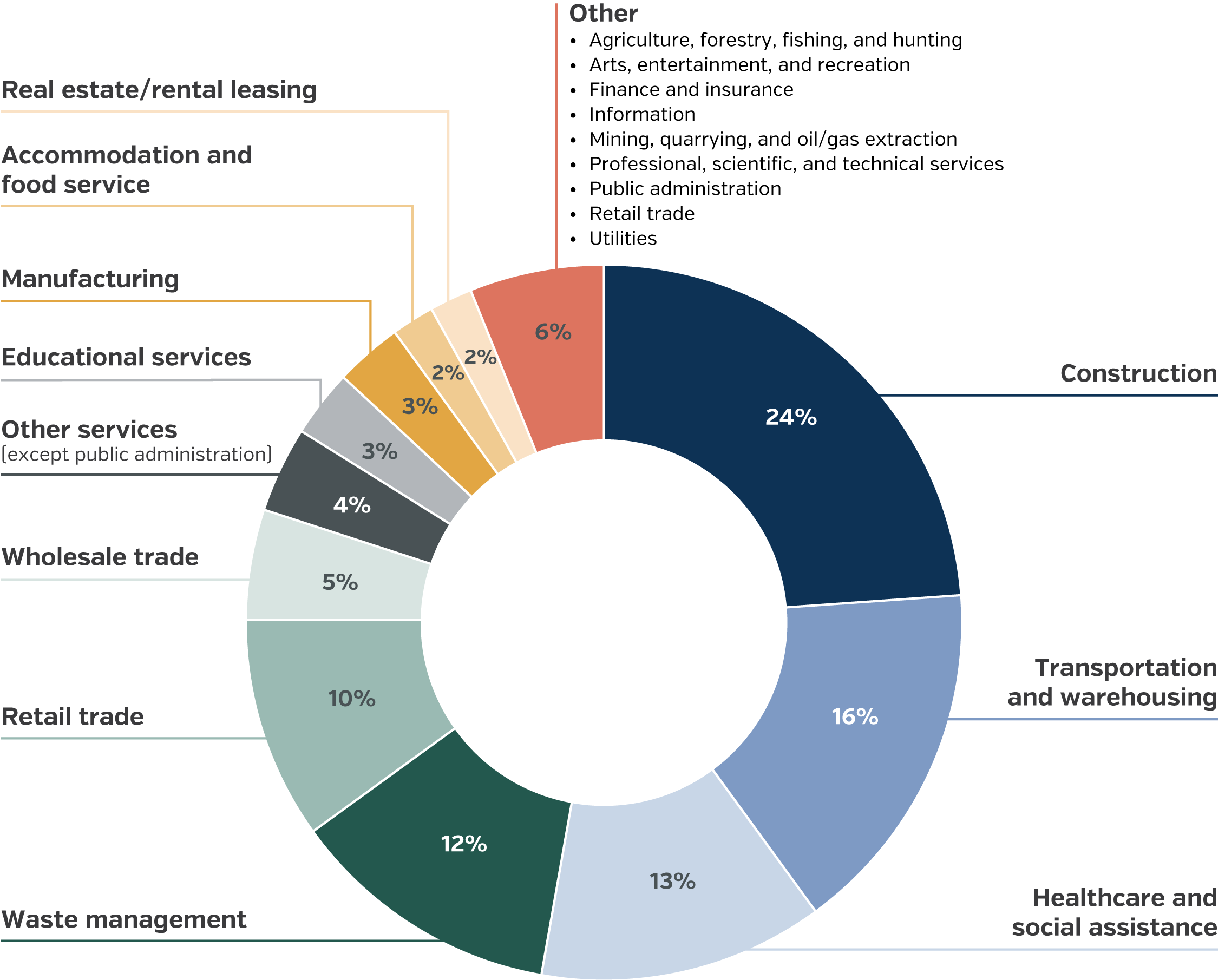
Top five industries that reported the most expensive motor vehicle accident injuries based on lost-time and medical-only claims during 2022–2024 for Summit-managed insurers.2
- Construction: Includes contractors working in heating, air conditioning, plumbing, site preparation, poured concrete foundation and structure, electrical, and roofing.
- Transportation/warehousing: Includes employees of local freight trucking, transit and ground passenger transportation, specialized freight trucking, used household and office goods, moving, social and trade services, courier, and express delivery services.
- Administrative and support/waste management remediation services: Includes employees of landscaping companies, professional employer organizations, janitorial services, building and dwelling services, and security system services.
- Healthcare and social assistance: Includes employees of home healthcare services, other family services, physician offices, residential care facilities, and ambulance services.
- Retail trade: Includes employees of car dealerships, building material suppliers, furniture stores, pharmacies and drug stores, and motorcycle and ATV dealerships.
Examining our latest motor vehicle accidents data in detail
Summit’s internal data shows that motor vehicle accidents accounted for 6% of the total claims reported from 2022 to 2024. Our data also reveals that even industries not in our top five (listed above) are significantly affected by motor vehicle accidents.2 Looking at the number of motor vehicle accidents as a percentage of overall claims by industry reveals that some industries are affected by motor vehicle accidents more than expected.
The good news is that many of these accidents can be avoided with proper education and safety measures. Employers play a key role in mitigating risks by providing proper education on job-specific hazards, conducting safety assessments, and providing corrective actions when needed.
Motor vehicle accident claims reported by industry
Based on lost-time and medical-only claims during 2022–2024 for Summit-managed insurers.2
Driver safety tips for employers
Collect and save vehicle data
- Run a Motor Vehicle Record (MVR) for all employees driving for business purposes. This report includes information from your state’s Department of Motor Vehicles, such as driver’s license information, point history, violations, convictions, and license status.
- Consider using in-vehicle monitoring systems to detect possible signs of fatigue, such as lane departures.
- During incident investigations, collect data on sleep history of workers involved, hours worked leading up to the incident, time of day, hours of driving, etc.1,4
Provide employee training on distracted driving and fatigue
- Communicate potential hazards and safe driving practices.
- Promote a workplace atmosphere that allows for self reporting of fatigue.
- When fatigue is reported, reschedule road time to avoid incidents.
- Use safety resources and videos provided on the Summit website.
- Establish clear expectations for your drivers, list driver safety policies with repercussions if these are not followed.1
- Teach how distracted driving puts them at risk of a crash.
- Driving requires their full attention while they are on the road.2
Provide cell phone usage instructions
- Ban cell phone use while driving a company vehicle and apply the same rules to use of a company-issued phone while driving a personal vehicle.
- Require workers to pull over in a safe location if they must text, make a call, or look up directions.
- Specify consequences for not following company policies.4
Driver safety tips for employees
Safety tips for drivers
- Always wear a seat belt and require passengers do the same.
- Make necessary adjustments (e.g., adjust controls, program directions) to your car before you begin driving.
- Avoid driving fatigued by aiming for at least seven hours of sleep each day. Report fatigue to your employer to prevent incidents.
- Watch yourself and your peers for fatigue-related symptoms.
- Speak honestly if you are questioned about a fatigue-related incident. Fatigue is a normal biological response—it’s not a reflection of how well you do your job.
- Evaluate road and traffic conditions before traveling and drive appropriately for them.
- Focus on the driving environment, such as the vehicles around you, cyclists, and anything that requires a quick response.4,5
- Maintain sufficient following distance from the vehicle in front of you and allow more space when traveling faster speeds. Think of the three-second rule: It should take three seconds for you to reach the same marker as the vehicle in front of you.
Did you know?
- More than 21,000 workers in the U.S. died in a work-related motor vehicle crash between 2011–2022 (35% of all work-related deaths).1
- Distracted drivers cause more than 424,000 injuries and nearly 3,100 deaths in the United States each year.3
- More than 120 people die each day in car crashes. Nine of those fatalities are a result of distracted driving.3,6
- About 1 in 5 fatal crashes involves driver fatigue.4
Summit’s safety team is here for you.

Safety consultants can assist in injury prevention by:
- Providing assistance and training for hazard identification, job safety analysis, and incident investigations
- Conducting site surveys
- Providing recommended solutions to improve safety
- Our employers and agents have access to an extensive library of online safety training videos and supplemental materials. Insureds and agents can request login credentials via email. (Videos provided through JER HR Group LLC, dba Training Network, a Summit vendor.)
Ensuring the safety of your workers is crucial for running an efficient and lucrative business.
Your employees are essential to your business’s productivity and success, so it makes sense that you invest in their health and well-being.
Summit is here to support you in that goal—not only by providing premier workers’ comp coverage—but also by offering resources to help educate you and your employees on safe work practices.
Contact Summit Loss Prevention at 1-800-282-7648.
Footnotes
- “About Motor Vehicle Safety at Work,” Centers for Disease Control and Prevention, U.S. Dept. of Health and Human Services, May 16, 2024, https://www.cdc.gov/niosh/motor-vehicle/about/ (Accessed Jun. 6, 2026).
- This information was obtained from insurers managed by Summit from 01/01/2022 to 12/31/2024.
- “Distracted Driving,” Centers for Disease Control and Prevention, U.S. Dept. of Health and Human Services, May 16, 2024, https://www.cdc.gov/distracted-driving/about/ (Accessed Jun. 6, 2026).
- “Driver Fatigue on the Job,” Centers for Disease Control and Prevention, U.S. Dept. of Health and Human Services, Apr. 3, 2024, https://www.cdc.gov/niosh/motor-vehicle/driver-fatigue/ (Accessed Jun. 6, 2026).
- “Distracted Driving at Work,” Centers for Disease Control and Prevention, U.S. Dept. of Health and Human Services, Mar 5, 2024, https://www.cdc.gov/niosh/motor-vehicle/distracted-driving/ (Accessed Jun. 6, 2026).
- “About Transportation Safety,” Centers for Disease Control and Prevention, U.S. Dept. of Health and Human Services, Nov. 19, 2024, https://www.cdc.gov/transportation-safety/about/index.html (Accessed Jun. 6, 2026).
The information presented in this publication is intended to provide guidance and is not intended as a legal interpretation of any federal, state or local laws, rules or regulations applicable to your business. The loss prevention information provided is intended only to assist policyholders of Summit managed insurers in the management of potential loss producing conditions involving their premises and/or operations based on generally accepted safe practices. In providing such information, Summit Consulting LLC does not warrant that all potential hazards or conditions have been evaluated or can be controlled. It is not intended as an offer to write insurance for such conditions or exposures. The liability of Summit Consulting LLC and its managed insurers is limited to the terms, limits, and conditions of the insurance policies underwritten by any of them.