Our Latest Safety Data for Manufacturing
From steel construction to woodworking, manufacturing businesses are vital to our economy. Manufacturing companies take raw materials, parts, components, and turn them into finished goods.
Let’s look at the most common workers’ comp claims in manufacturing based on our internal data—and the key recommended measures to avoid them.
Top five reported injuries in the manufacturing industry
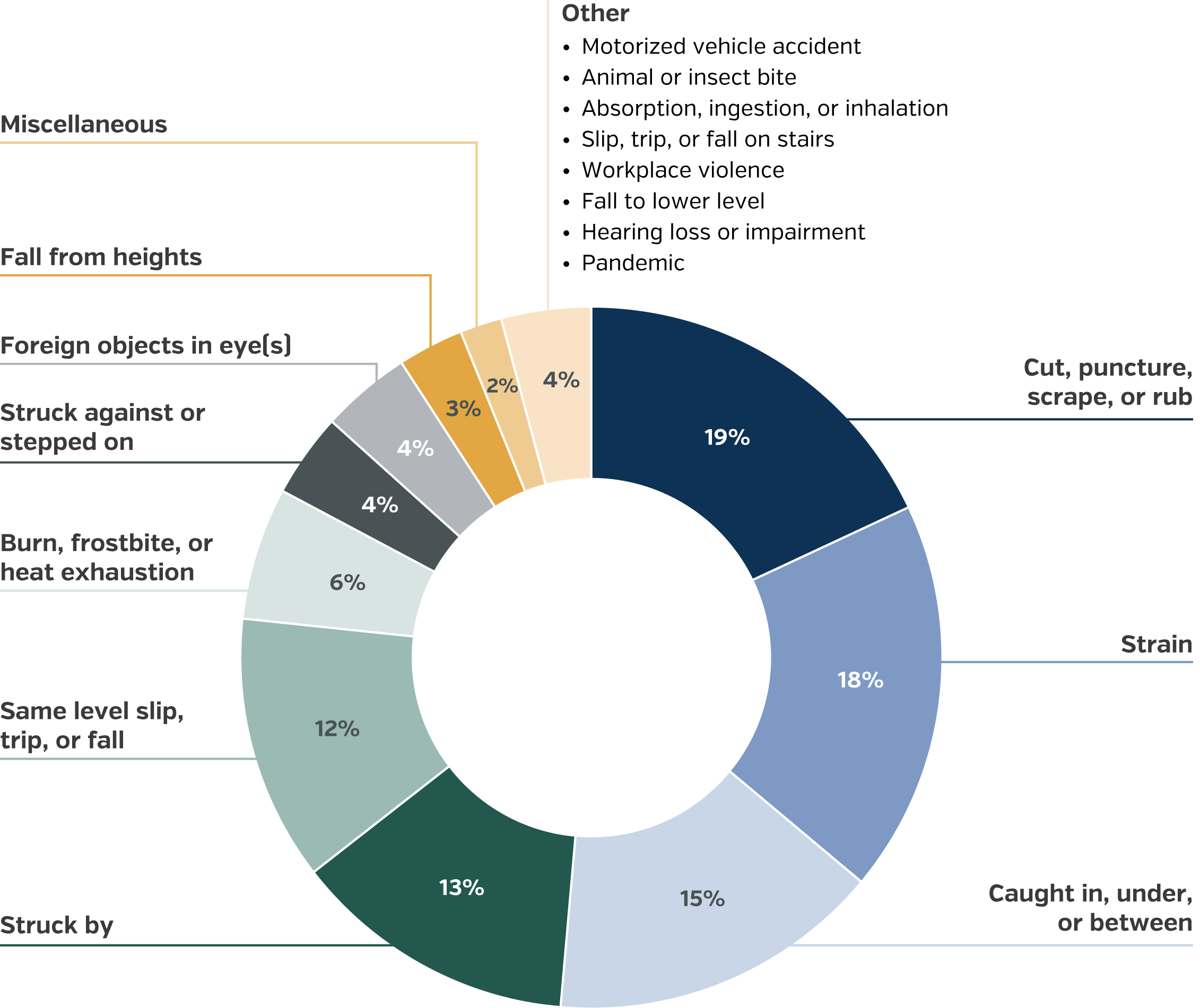
The five most reported manufacturing injuries based on lost-time and medical-only claims during 2022–2025 for Summit-managed insurers.1
- Cut, puncture, scrape, or rub: Involving injuries by sharp objects or tools.
- Strain: Involving lifting, twisting, pushing, or pulling of materials.
- Caught in, under, or between: Involving injuries where the employee is caught, crushed, pinched, or compressed between two objects.
- Struck by: Involving improperly placed work materials or equipment and contact with falling objects.
- Same level slip, trip, or fall: Involving inappropriate walking stride, slippery, or uneven walking surfaces.
The bigger picture on our manufacturing injnury data
Numerous risks are associated with working on a manufacturing site. The most common injuries by body part were fingers, hands, eyes, lower back, and shoulder. Generally, injuries can be avoided by implementing effective risk control practices and procedures.1
Employers play a key role in mitigating risks by providing proper education on job-specific hazards, conducting safety assessments, and providing corrective actions when needed.
Injuries reported in manufacturing
Based on lost-time and medical-only claims during 2022–2025 for Summit-managed insurers.1
Key safety measures that help prevent manufacturing injuries
Prevent being cut, punctured, scraped, or rubbed by an object
- Wear proper personal protective equipment (PPE), such as cut-resistant gloves and protective clothing.4
- Use the proper tool for the job at hand.8
- Use a sharp blade; a dull blade means a worker has to exert more force when cutting.3
- Never leave an exposed blade unattended or place an open blade in your pocket.8
Preventing strains
- Use mechanical aids whenever possible. Manual handling, such as lifting and carrying, can be easier and safer when mechanized by using lift tables, conveyors, yokes, or trucks.
- Train employees in proper lifting techniques. When lifting and carrying a heavy object, lift with your legs and tighten your core muscles.
- Pay attention to posture. When standing, balance your weight evenly on your feet.
- Listen to your body. For instance, if you’re experiencing discomfort or feeling tired, take a break.6
Preventing being caught in, under, or between objects
- Before working on machinery, make sure it’s completely powered down and use proper lockout/tagout safety procedures.3,10
- Don’t wear loose clothing that could get pulled into a machine.4
- Learn how machinery works, what moving parts it has, and where the entry and exit points are located.3,5
- Pay attention to the task at hand and avoid activities that may be a distraction.10
Prevent being struck by an object
- Stack materials properly to prevent sliding, falling, or collapsing.
- Secure tools and materials so they do not fall on people below. Inspect tools to ensure proper guards are in
place.9 - Use safety guards, emergency stop devices, and ergonomic tools. Provide employees with safety training, lockout and tagout rules, and warning signs.6,7
- Inspect cranes and hoists to check that all components, such as wire rope, lifting hooks, chains, etc., are in good condition.9
Preventing same level slip, trip, or fall
- Maintain floors by keeping them clean, dry, and free of potential slip and trip hazards.
- Clean spills immediately. Keep wet floor signs and cleaning tools close to moisture-prone areas.
- Keep aisles and passageways clean and in good repair, with no obstructions across or in aisles that can create a hazard. Keep at least 3 feet of clearance.
- Don’t leave tools, materials, boxes, cords, cables, or hoses on the floor.11
Did you know?
- Back disorders are one of the leading causes of disability for the nation’s workforce.2
- Nearly half of all workplace amputations occur in the manufacturing industry.3
- According to the Occupational Safety and Health Administration (OSHA), controlling a hazard at its source is the best way to protect employees.4
Summit’s safety team is here for you.
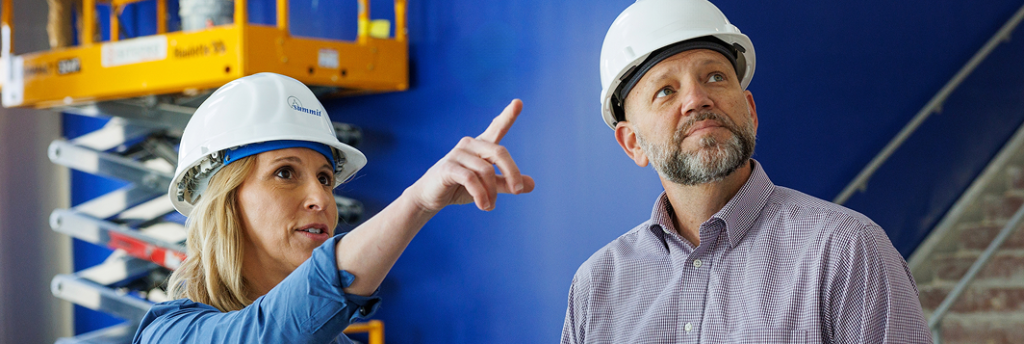
Safety consultants can assist in injury prevention by:
- Providing assistance and training for hazard identification, job safety analysis, and incident investigations
- Conducting site surveys
- Providing recommended solutions to improve safety
- Our employers and agents have access to an extensive library of online safety training videos and supplemental materials. Insureds and agents can request login credentials via email. (Videos provided through JER HR Group LLC, dba Training Network, a Summit vendor.)
Ensuring the safety of your workers is crucial for running an efficient and lucrative business.
Your employees are essential to your business’s productivity and success, so it makes sense that you invest in their health and well-being.
Summit is here to support you in that goal—not only by providing premier workers’ comp coverage—but also by offering resources to help educate you and your employees on safe work practices.
Contact Summit Loss Prevention at 1-800-282-7648.
Footnotes
- This information was obtained from insurers managed by Summit from 01/01/2022 to 12/31/2025.
- “OSHA Technical Manual, Section VII, Chapter 1,” OSHA, https://www.osha.gov/dts/osta/otm/otm_vii/otm_vii_1.html (Accessed Jun. 6, 2026).
- “Safeguarding Equipment and Protecting Employees from Amputations,” OSHA, 2007, https://www.osha.gov/Publications/osha3170.pdf (Accessed Jun. 6, 2026).
- “Personal Protective Equipment,” OSHA, 2023, https://www.osha.gov/Publications/osha3151.pdf. (Accessed Jun. 6, 2026).
- “Preventing Lower Back Injury in the Workplace,” OSHA.net, OSHA-Pros USA, LLC, April 20, 2015, http://www.osha.net/workplace-safety/safety-training-prevent-workplace-low-back-injury/ (Accessed Jun. 6, 2026).
- “Ergonomics: Solutions to Control Hazards,” OSHA, https://www.osha.gov/SLTC/ergonomics/controlhazards.html (Accessed Jun. 6, 2026).
- “Guide for Protecting Workers from Woodworking Hazards,” U.S. Department of Labor, Occupational Safety and Health Administration, 1999, https://www.osha.gov/sites/default/files/publications/osha3157.pdf (Accessed
Jun. 6, 2026). - “Hand and Power Tools,” U.S. Department of Labor, Occupational Safety and Health Administration, 2002, https://www.osha.gov/sites/default/files/publications/osha3080.pdf (Accessed Jun. 6, 2026).
- “Construction eTool, Struck by Falling/Flying Objects,” U.S. Department of Labor, Occupational Safety and Health Administration, https://www.osha.gov/etools/construction/struck-by/ (Accessed Jun. 6, 2026).
- “Caught by Construction Manual Class,” OSHA, April 2011, https://www.osha.gov/sites/default/files/caught_iorb_ig.pdf (Accessed Jun. 6, 2026).
- “Training Requirements in OSHA Standards,” Occupational Safety and Health Administration, U.S. Department of Labor, 2015, http://www.osha.gov/Publications/osha2254.pdf (Accessed Jun. 6, 2026).
The information presented in this publication is intended to provide guidance and is not intended as a legal interpretation of any federal, state or local laws, rules or regulations applicable to your business. The loss prevention information provided is intended only to assist policyholders of Summit managed insurers in the management of potential loss producing conditions involving their premises and/or operations based on generally accepted safe practices. In providing such information, Summit Consulting LLC does not warrant that all potential hazards or conditions have been evaluated or can be controlled. It is not intended as an offer to write insurance for such conditions or exposures. The liability of Summit Consulting LLC and its managed insurers is limited to the terms, limits, and conditions of the insurance policies underwritten by any of them.