
Our Latest Data on Injuries Among New Employees
Did you know that 40% of all workplace injuries involve employees who have been on the job for less than one year? Even more staggering, 1 in 8 injuries occur on an employee’s first day of a new job.1
Summit’s data reflects that 52% of claims reported involved employees with less than one year of job tenure. This emphasizes the importance of early and comprehensive training.
Let’s look at the most common injuries we’ve seen among less tenured employees and some recommendations on how to keep both new—and more experienced—employees safe.
Top five injuries in the first year of employment
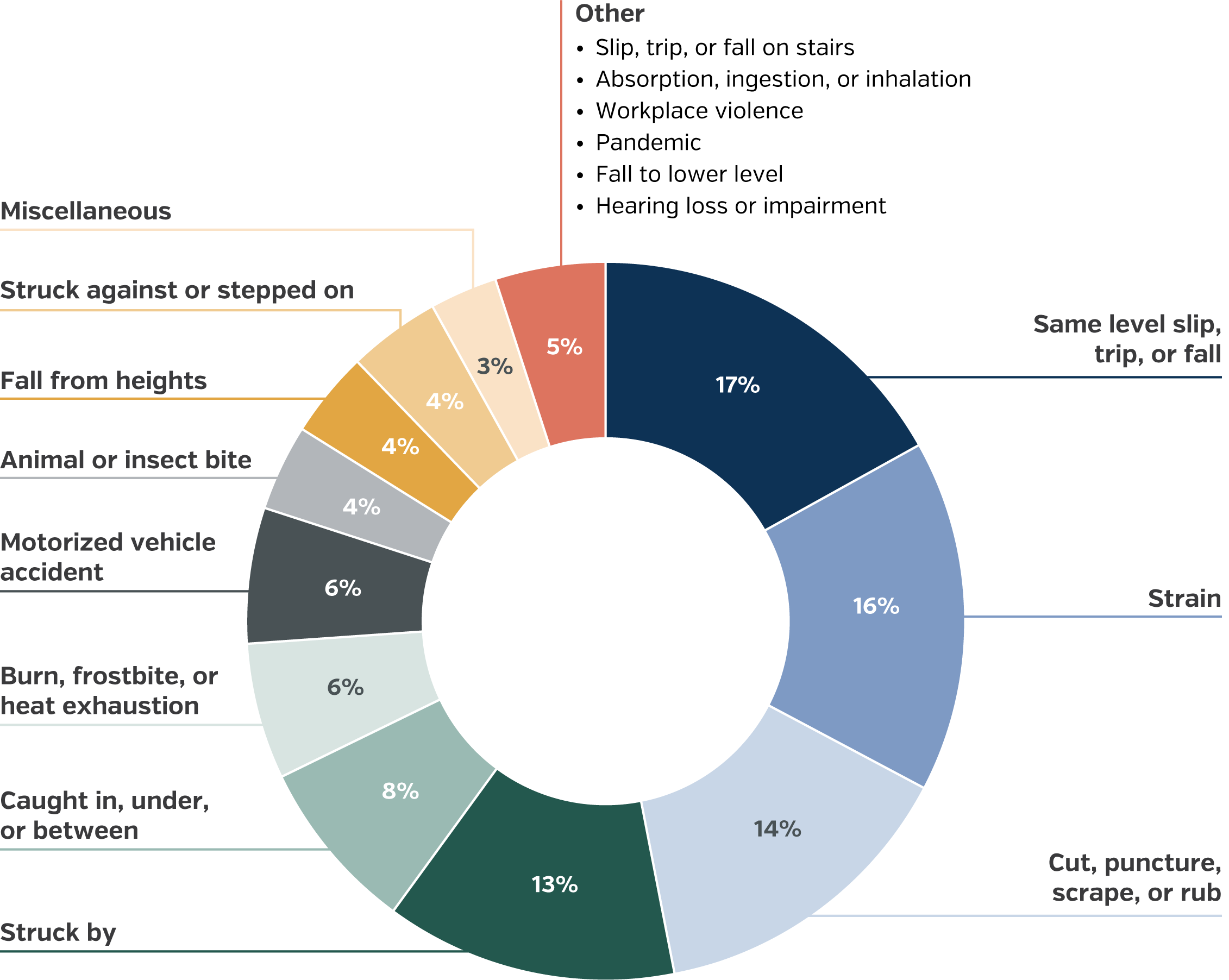
Here are the top five newly hired employee injuries based on lost-time and medical-only claims during 2022–2025 for Summit managed insurers.2
- Same level slip, trip, or fall: Involving misplaced objects or liquid spills in stairways or walkways.
- Strain: Involving lifting, twisting, pushing, and pulling of materials.
- Cut, puncture, scrape, or rub: Using inappropriate personal protective equipment, inadequate equipment, or having misplaced objects in a work area.
- Struck by: Involving improperly placed work materials or equipment or contact with falling objects.
- Caught in, under, or between: Involving injuries where the employee is caught, crushed, pinched, or compressed between two objects.
Less time on the job, more risk of injury!
New employees tend to be at greater risk of workplace injuries as they learn to navigate unfamiliar territory, such as operating equipment they’ve never used or working around potentially harmful chemicals. Providing early and thorough training can help keep newer employees safe and build a strong safety culture for your business.
Employers play a key role in mitigating risks by providing proper education on job-specific hazards, conducting safety assessments, and providing corrective actions when needed.
Recently hired employee claims
Here’s a breakdown of the injury types reported for claims involving employees with less than one year of tenure across all industries. This is based on lost-time and medical-only claims during 2022–2025 for Summit-managed insurers.2
Building a comprehensive safety training program
Here are some tips on how to build a comprehensive safety training program for your business to help reduce the risk of injury for less tenured employees while also keeping your experienced employees safe.
Establish supervisor and manager accountability
- Safety should be treated as high priority by all levels of management.
- Communicate the importance of sharing job-specific safety rules, policies, and procedures with employees.
- Implement a workplace safety program and name a safety coordinator.
- Establish an evaluation process to confirm that new employees understand safety protocols.3
Identify and assess job hazards
- Educate employees on how to perform their tasks step-by-step.
- Clearly communicate any hazards associated with a task and safety measures in place to eliminate hazards.
- Implement policies for inspecting equipment and work conditions for safety.
- Educate employees on how to report unsafe working conditions.4
Provide frequent and comprehensive safety training
- Communicate safety expectations during hiring and onboarding of new employees.
- Provide training to new hires, anyone assigned to a new task and routine refresher courses for tenured employees.
- Document all safety training.
- Assign a mentor to your new employees. Peer‑to‑peer and hands‑on training are effective methods to promote safety awareness and hazard control.5
Supplement training with videos
- Educate new employees on a variety of topics with online safety training videos.
- Use videos for refresher training for existing employees.
- Provide videos on specific topics following an incident or near miss.
- Add videos to safety meetings or toolbox topics to reinforce safe work practices.
Tips to help keep less tenured employees safe
- Discuss safety expectations during new employee onboarding.
• Provide early and comprehensive safety training for new employees and anyone assigned to an unfamiliar task. - Communicate hazards associated with a task and safety measures in place to eliminate hazards. Assign a mentor to each new employee to help provide on-the-job training and develop a positive safety attitude.
- Make sure all employees know how to report unsafe working conditions.
Summit’s safety team is here for you.

Safety consultants can assist in injury prevention by:
- Providing assistance and training for hazard identification, job safety analysis, and incident investigations
- Conducting site surveys
- Providing recommended solutions to improve safety
- Our employers and agents have access to an extensive library of online safety training videos and supplemental materials. Insureds and agents can request login credentials via email. (Videos provided through JER HR Group LLC, dba Training Network, a Summit vendor.)
Ensuring the safety of your workers is crucial for running an efficient and lucrative business.
Your employees are essential to your business’s productivity and success, so it makes sense that you invest in their health and well-being.
Summit is here to support you in that goal—not only by providing premier workers’ comp coverage—but also by offering resources to help educate you and your employees on safe work practices.
Contact Summit Loss Prevention at 1-800-282-7648.
Footnotes
- “The Risks with New Employees and What to Do About Them?” Simplified Safety, Inc. simplifiedsafety.com/blog/risks-of-being-new-employee/ (Accessed Jun. 6, 2026)
- This information was obtained from insurers managed by Summit from 01/01/2022 to 12/31/2025.
- “New Employees at Risk for Workplace Injuries.” SHRM, June 30, 2022, www.shrm.org/topics-tools/employment-law-compliance/new-employees-risk-workplace-injuries (Accessed Jun. 6, 2026)
- “Recommended Practices for Safety and Health Programs,” Occupational Safety and Health Administration, https://www.osha.gov/safety-management (Accessed Jun. 6, 2026)
- “Recommended Practices for Safety and Health Programs,” OSHA, https://www.osha.gov/safety-management/education-training (Accessed Jun. 30, 2026).
The information presented in this publication is intended to provide guidance and is not intended as a legal interpretation of any federal, state or local laws, rules or regulations applicable to your business. The loss prevention information provided is intended only to assist policyholders of Summit managed insurers in the management of potential loss producing conditions involving their premises and/or operations based on generally accepted safe practices. In providing such information, Summit Consulting LLC does not warrant that all potential hazards or conditions have been evaluated or can be controlled. It is not intended as an offer to write insurance for such conditions or exposures. The liability of Summit Consulting LLC and its managed insurers is limited to the terms, limits, and conditions of the insurance policies underwritten by any of them.