

Our Latest Safety Data for Food Service
The food service industry includes full and limited-service restaurants, caterers, mobile food services, and drinking establishments.1
Work-related injuries are common in this industry due to the variety of services provided and tasks performed.
Let’s look at the most common injuries in our data and recommended tips to help avoid them.
Top five reported injuries in food service
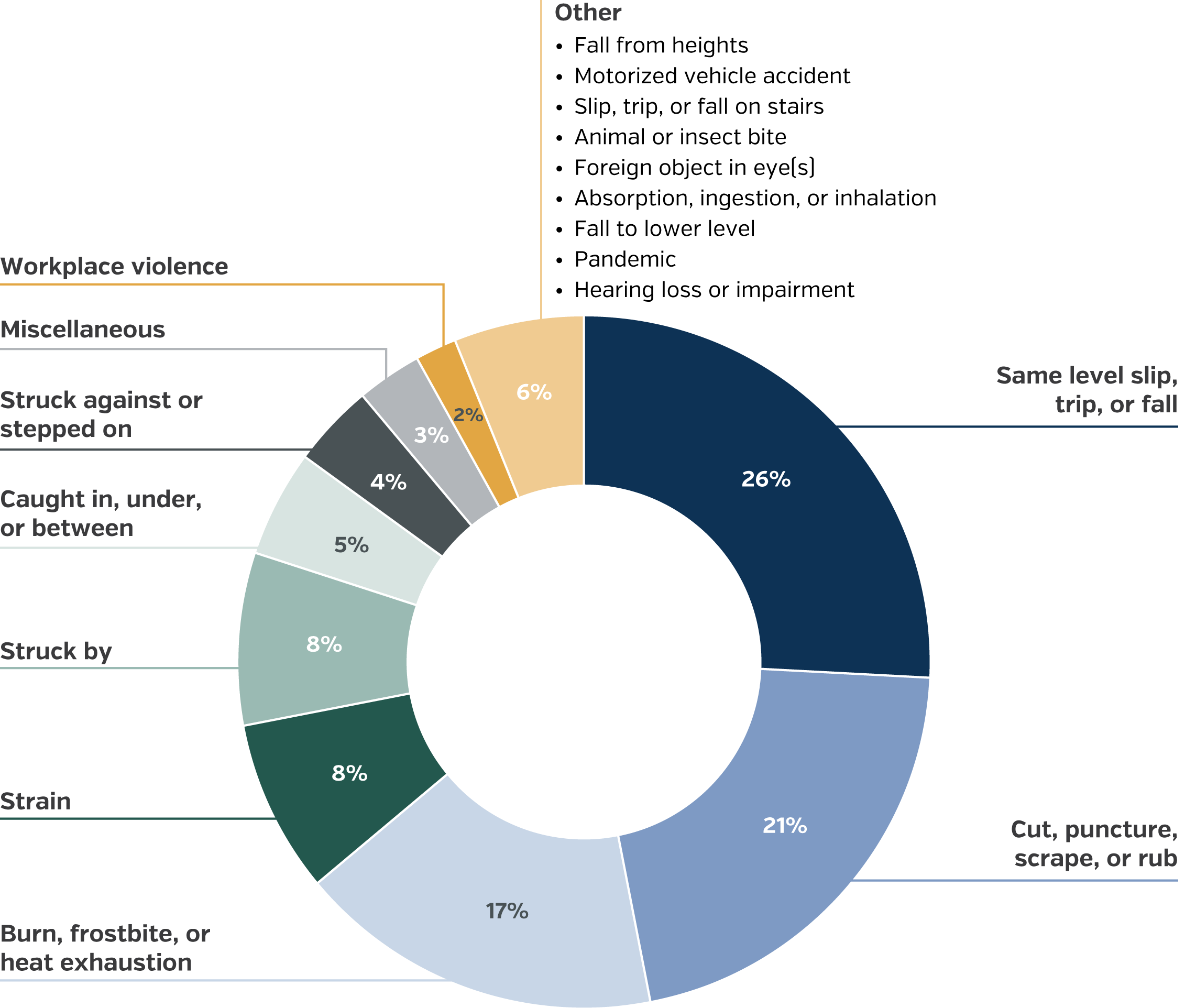
The five most reported injuries in food service based on lost-time and medical-only claims during 2022–2025 for Summit-managed insurers.2
- Same level slip, trip, or fall: Involving food or liquid spills on floors, wet or uneven surfaces, cluttered floors, or not wearing slip resistant shoes.
- Cut, puncture, scrape, or rub: Involving missing guards on equipment, not wearing cut resistant gloves while using sharp blades, or discarding the trash.
- Burn, frostbite, or heat exhaustion: Involving contact with hot plates, steam, and hot surfaces (grills, ovens, stoves), improper use of fryers, or overexposure to cold temperatures.
- Strain: Involving improper lifting and carrying, overreaching, repetitive movement, bad posture, poor physical condition, prolonged standing, or moving heavy items.
- Struck by: Involving faulty equipment, improperly stored materials, poor housekeeping, one way exit and entry door to kitchen, or workplace violence.
A detailed look at our food service industry safety data
Summit’s internal data shows that the most common body parts injured in food service are fingers, hands, knees, lower back, and thumbs.2 With a great deal of multitasking in the fast-paced environment of the food service industry, injuries happen. Many of these injuries can be avoided with proper education and safety measures.
Employers can play a key role in mitigating risks by providing proper education on job-specific hazards, conducting safety assessments, and providing corrective actions when needed.
Injuries reported among food service employees
Key safety measures that help food service employees avoid injuries
Preventing same level slip, trip, or fall
- Use nonslip mats in the kitchen.
- Wipe up liquid and food spills immediately.
- Wear comfortable, slip-resistant shoes.
- Carry items at a height that keeps vision clear.
- Provide proper storage so walkways and work areas are free of clutter.6,7
Preventing being cut, punctured, scraped, or rubbed by an object
- Require employees to wear personal protective equipment, such as steel mesh or Kevlar gloves, to protect against cuts and scrapes.
- Never leave knives soaking in water.
- Use a knife only for its purpose and always use the appropriate knife for the job.
- Designate one clearly marked trash can for broken glass and sharp can lids.
- Properly store knives in blocks or racks.
- Avoid cutting with a knife while distracted.5
Preventing burns, frostbite, or exhaustion
- Don’t strain or carry hot oil. Wait until it is cool.
- Wear temperature-appropriate clothing and drink plenty of fluids.
- Never reach over an open flame.
- Wear protective gloves and mitts when exposed to heat or cold.
- Avoid spilling water or ice into hot oil or storing drinks by deep fryers. (Deep fryers are the number one cause of burns.)8
Preventing strains
- Lift with your legs, not your back.
- Install tables and chairs permanently so they don’t have to be set up and taken down daily.
- Don’t bend or reach to get a heavy or awkward item. Ask for help to lift and move it properly.
- Redesign drive-through windows so workers don’t have to stretch to serve customers.
- Provide small bus pans and trays.8,9
Preventing being struck by object
- Maintain proper stocking practices so stored materials and objects do not fall.
- Use flashlights and high visibility vests for valet employees working at night.
- Use two-way doors with windows in high traffic areas to avoid collisions. Separate exit and entry doors in the kitchen are ideal.
- Lay out the dining room and kitchen without tight or blind corners to avoid collisions.
- Train workers on what to do in case of robbery, crime, or a potentially violent situation.4
Did you know?
- Restaurants and other eating and drinking establishments employ 11.6 million people in the United States, and nearly 30 percent of them are younger than 20 years old.3
- It’s important to remember that workers under the age of 16 are not allowed to bake, and they can only do light cooking with electric or gas grills that do not involve an open flame.
- Workers under the age of 18 are not allowed to use, clean, take apart, or assemble large electrical appliances, such as automatic slicers and bakery machines.4
Summit’s safety team is here for you.

Safety consultants can assist in injury prevention by:
- Providing assistance and training for hazard identification, job safety analysis, and incident investigations
- Conducting site surveys
- Providing recommended solutions to improve safety
- Our employers and agents have access to an extensive library of online safety training videos and supplemental materials. Insureds and agents can request login credentials via email. (Videos provided through JER HR Group LLC, dba Training Network, a Summit vendor.)
Ensuring the safety of your workers is crucial for running an efficient and lucrative business.
Your employees are essential to your business’s productivity and success, so it makes sense that you invest in their health and well-being.
Summit is here to support you in that goal—not only by providing premier workers’ comp coverage—but also by offering resources to help educate you and your employees on safe work practices.
Contact Summit Loss Prevention at 1-800-282-7648.
Footnotes
- “Industries at a Glance; Food Service and Drinking Places: NAICS 722,” U.S. Bureau of Labor Statistics, Nov. 10, 2020, www.bls.gov/iag/tgs/iag722.htm (Accessed Jun. 6, 2026).
- This information was obtained from insurers managed by Summit from 01/01/2022 to 12/31/2025.
- “Youth Worker Safety in Restaurants ETool,” Occupational Safety and Health Administration, http://www.osha.gov/SLTC/youth/restaurant/hazards_development.html (Accessed Jun. 6, 2026).
- “Young Worker Safety in Restaurants ETool: Drive-Thru,” Occupational Safety and Health Administration, https://www.osha.gov/etools/young-workers-restaurant-safety/drive-thru (Accessed Jun. 6, 2026).
- “Youth Worker Safety in Restaurants ETool: Food Preparation – Knives and Cuts,” Occupational Safety and Health Administration, https://www.osha.gov/etools/young-workers-restaurant-safety/food-prep (Accessed Jun. 6, 2026).
- “Youth Worker Safety in Restaurants ETool: Serving – Slips/Trips/Falls,” Occupational Safety and Health Administration, https://www.osha.gov/etools/young-workers-restaurant-safety/serving (Accessed Jun. 6, 2026).
- “Youth Worker Safety in Restaurants ETool: General Hazards – Slips/Trips/Falls,” Occupational Safety and Health Administration, https://www.osha.gov/etools/young-workers-restaurant-safety/general (Accessed Jun. 6, 2026).
- “Youth Worker Safety in Restaurants ETool: Cooking, Burns,” Occupational Safety and Health Administration, https://www.osha.gov/etools/young-workers-restaurant-safety/cooking (Accessed Jun. 6, 2026).
- “Youth Worker Safety in Restaurants ETool: Delivery/Storage – Strains and Sprains,” Occupational Safety and Health Administration, https://www.osha.gov/etools/young-workers-restaurant-safety/delivery (Accessed Jun. 6, 2026).
The information presented in this publication is intended to provide guidance and is not intended as a legal interpretation of any federal, state or local laws, rules or regulations applicable to your business. The loss prevention information provided is intended only to assist policyholders of Summit managed insurers in the management of potential loss producing conditions involving their premises and/or operations based on generally accepted safe practices. In providing such information, Summit Consulting LLC does not warrant that all potential hazards or conditions have been evaluated or can be controlled. It is not intended as an offer to write insurance for such conditions or exposures. The liability of Summit Consulting LLC and its managed insurers is limited to the terms, limits, and conditions of the insurance policies underwritten by any of them.