Our Latest Data on Safety for Construction
From towering skyscrapers to underground utilities, construction keeps our world running. But, it also ranks among the most hazardous industries. Our latest data pinpoints the most frequent injuries on job sites and outlines proven steps to prevent them.
Your crew depends on you—take action now to make safety a priority.
Let’s look at the top claims we see in this industry based on our internal data—and some recommended measures to avoid them.
Top five reported injuries in construction
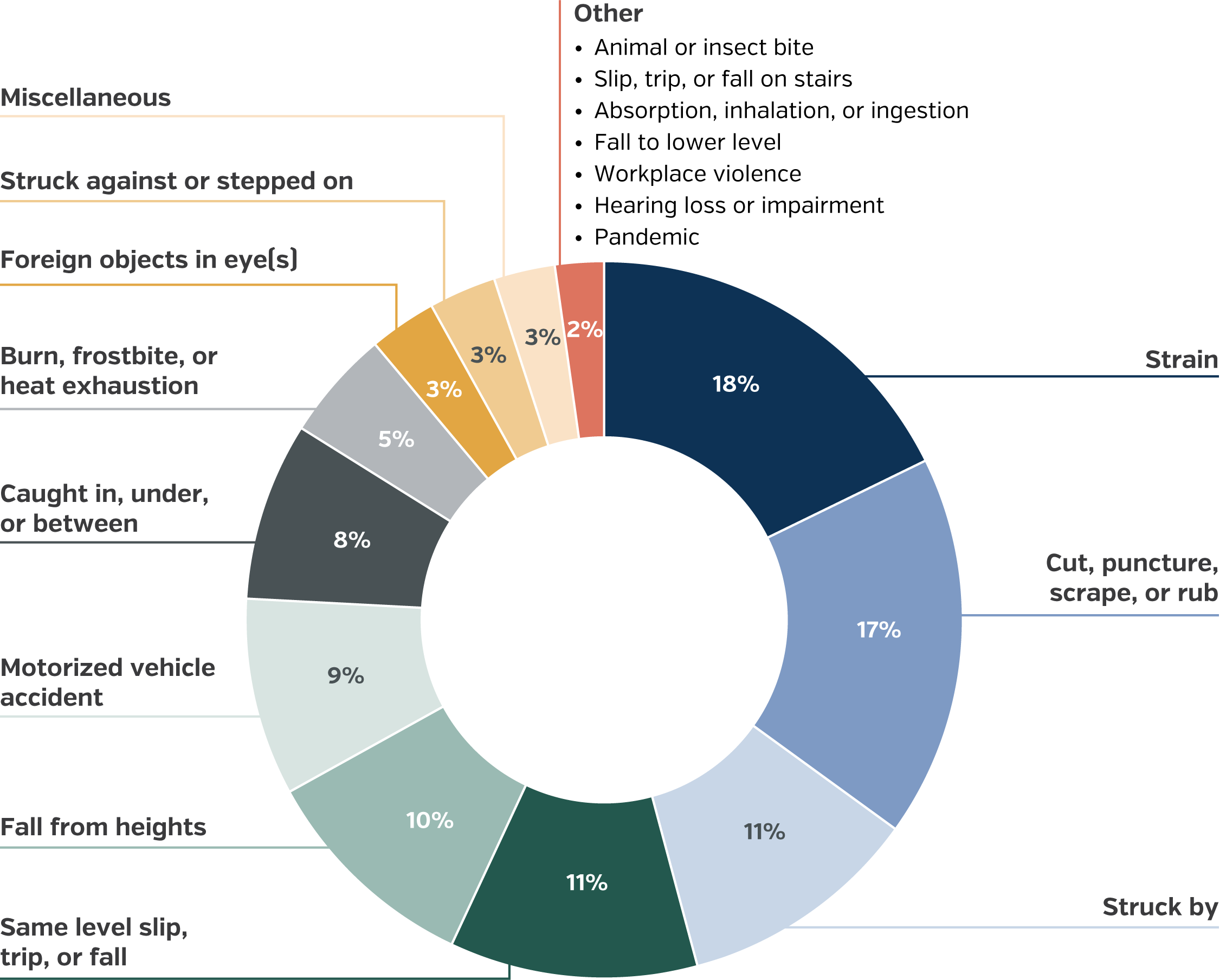
The five most reported construction injuries based on lost-time and medical-only claims during 2022–2025 for Summit-managed insurers.1
- Strain: Involving lifting, twisting, pushing, or pulling of materials.
- Cut, puncture, scrape, or rub: Using inappropriate personal protective equipment, inadequate equipment, or having improperly stored materials.
- Struck by: Involving improperly stored work materials or equipment.
- Same level slip, trip, or fall: Involving improperly placed objects or liquid spills in stairways or walkways.
- Fall from heights: Involving unstable working surfaces.
Examining our latest construction injury data in more detail
From 2022 through 2025, Summit received 118,667 workers’ compensation claims, and 17% of those claims were construction related. The most common injuries by body part are fingers, lower back, knees, and hands.1
Employers play a key role in mitigating risks by providing proper education on job-specific hazards, conducting safety assessments, and providing corrective actions when needed.
Injuries reported in construction
Based on lost-time and medical-only claims during 2022–2025 for Summit-managed insurers.1
Key safety measures that help prevent construction injuries
Preventing strains
- When lifting an item, keep it close to the body, and use the legs for power.
- Avoid twisting, especially when bending forward while lifting. Turn by moving the feet rather than twisting the torso.
- Use forklifts to lift heavy loads. Lifting loads heavier than about 50 pounds increases the risk of injury.
- Avoid carrying loads on one shoulder, under an arm, or in one hand, as this creates uneven pressure on the
spine.4
Preventing being cut, punctured, scraped, or rubbed by an object
- Use padding to reduce direct contact with hard, sharp, or vibrating surfaces.5
- Wear proper apparel for the task. Loose clothing or jewelry can become caught in moving parts.
- Unplug power tools before cleaning them and when changing accessories, such as blades, bits, and cutters.6
- Wear proper personal protective equipment (PPE), such as cut-resistant gloves and protective clothing.7
Preventing being struck by an object
- Secure tools and materials to prevent them from falling on people below.
- Lifting devices should not carry more than the manufacturer’s recommended load capacity.
- Stack materials properly to prevent sliding, falling, or collapse.
- Make sure that all personnel are in the clear before using dumping or lifting devices.3
Preventing same level slip, trip, or fall
- Slippery conditions on stairways and walkways must be corrected immediately.
- Stairways and walkways must be free of objects, debris, and materials.
- Tread should cover the entire step and landing.
- Stairways having four or more risers or rising more than 30 inches must have at least one handrail.8
Preventing falls from heights
- Position ladders so the side rails extend at least 3 feet above the landing.
- Inspect ladders before each use for cracked or broken parts, such as rungs, steps, side rails, feet, and locking
components. - Consider using aerial lifts or elevated platforms to provide safer elevated working surfaces.
- Use safety net systems or personal fall arrest systems (body harnesses).8
Did you know?
- Approximately 8.3 million people are employed by the construction industry; that’s about 3% of the U.S.
workforce.2 - One of every five workplace fatalities is a construction worker.3
Summit’s safety team is here for you.
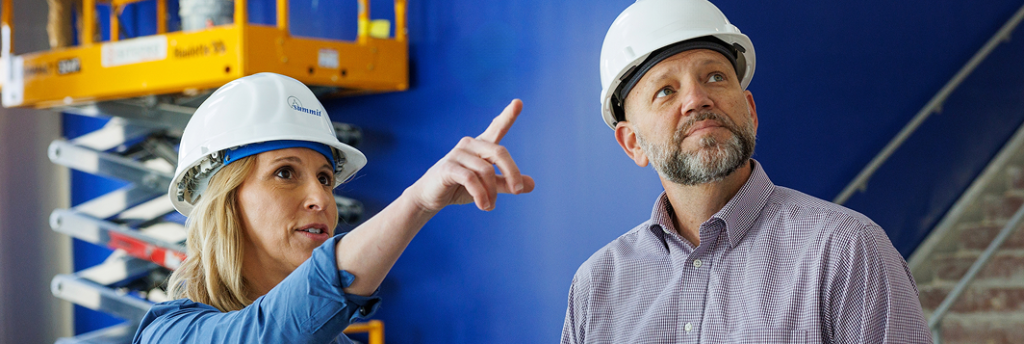
Safety consultants can assist in injury prevention by:
- Providing assistance and training for hazard identification, job safety analysis, and incident investigations
- Conducting site surveys
- Providing recommended solutions to improve safety
- Our employers and agents have access to an extensive library of online safety training videos and supplemental materials. Insureds and agents can request login credentials via email. (Videos provided through JER HR Group LLC, dba Training Network, a Summit vendor.)
Ensuring the safety of your employees is necessary to running an efficient and lucrative construction business.
Your team is essential to your business’s productivity and success, so it makes sense that you invest in their health and well-being.
Summit is here to support you in that goal—not only by providing premier workers’ comp coverage—but also by offering resources to help educate you and your employees on safe work practices.
Contact Summit Loss Prevention at 1-800-282-7648.
Footnotes
- This information was obtained from insurers managed by Summit from 01/01/2022 to 12/31/2025.
- “Industries at a Glance, Construction: NAICS 23,” U.S. Bureau of Labor and Statistics, https://www.bls.gov/iag/tgs/iag23.htm (Accessed Jun. 30, 2026).
- “Construction eTool, Struck by Falling/Flying Objects,” Occupational Safety and Health Administration, www.osha.gov/etools/construction (Accessed Jun. 6, 2026).
- “Ergonomics eTool, Solutions for Electrical Contractors,” Occupational Safety and Health Administration, www.osha.gov/etools/electrical-contractors/materials-handling/heavy (Accessed Jun. 6, 2026).
- “Ergonomics: Solutions to Control Hazards,” Occupational Safety and Health Administration, www.osha.gov/ergonomics/control-hazards (Accessed Jun. 6, 2026).
- “Power Tool Safety Tips from OSHA,” Occupational Health and Safety, Mar. 19, 2010, https://ohsonline.com/articles/2010/03/19/power-tool-safety-tips-from-osha.aspx (Accessed Jun. 6, 2026).
- “Personal Protective Equipment,” Occupational Safety and Health Administration, www.osha.gov/personal-protective-equipment (Accessed Jun. 6, 2026).
- “Worker Safety Series Construction,” OSHA, 2005, obis.osha.gov/Publications/OSHA3252/3252.html (Accessed Jun. 6, 2026).
The information presented in this publication is intended to provide guidance and is not intended as a legal interpretation of any federal, state or local laws, rules or regulations applicable to your business. The loss prevention information provided is intended only to assist policyholders of Summit managed insurers in the management of potential loss producing conditions involving their premises and/or operations based on generally accepted safe practices. In providing such information, Summit Consulting LLC does not warrant that all potential hazards or conditions have been evaluated or can be controlled. It is not intended as an offer to write insurance for such conditions or exposures. The liability of Summit Consulting LLC and its managed insurers is limited to the terms, limits, and conditions of the insurance policies underwritten by any of them.