

Our Latest Data on Safety for Delivery Drivers
Delivery drivers have an essential role in keeping the supply chain moving: ensuring that products arrive by the scheduled time and in good condition. This involves loading and unloading items onto and from delivery vehicles and entering unfamiliar surroundings to deliver items. Unforeseen obstacles can lead to workplace injuries during deliveries.
Let’s look at some of the more common injuries we’ve seen and recommended tips to help avoid them.
Top five reported injuries for delivery drivers
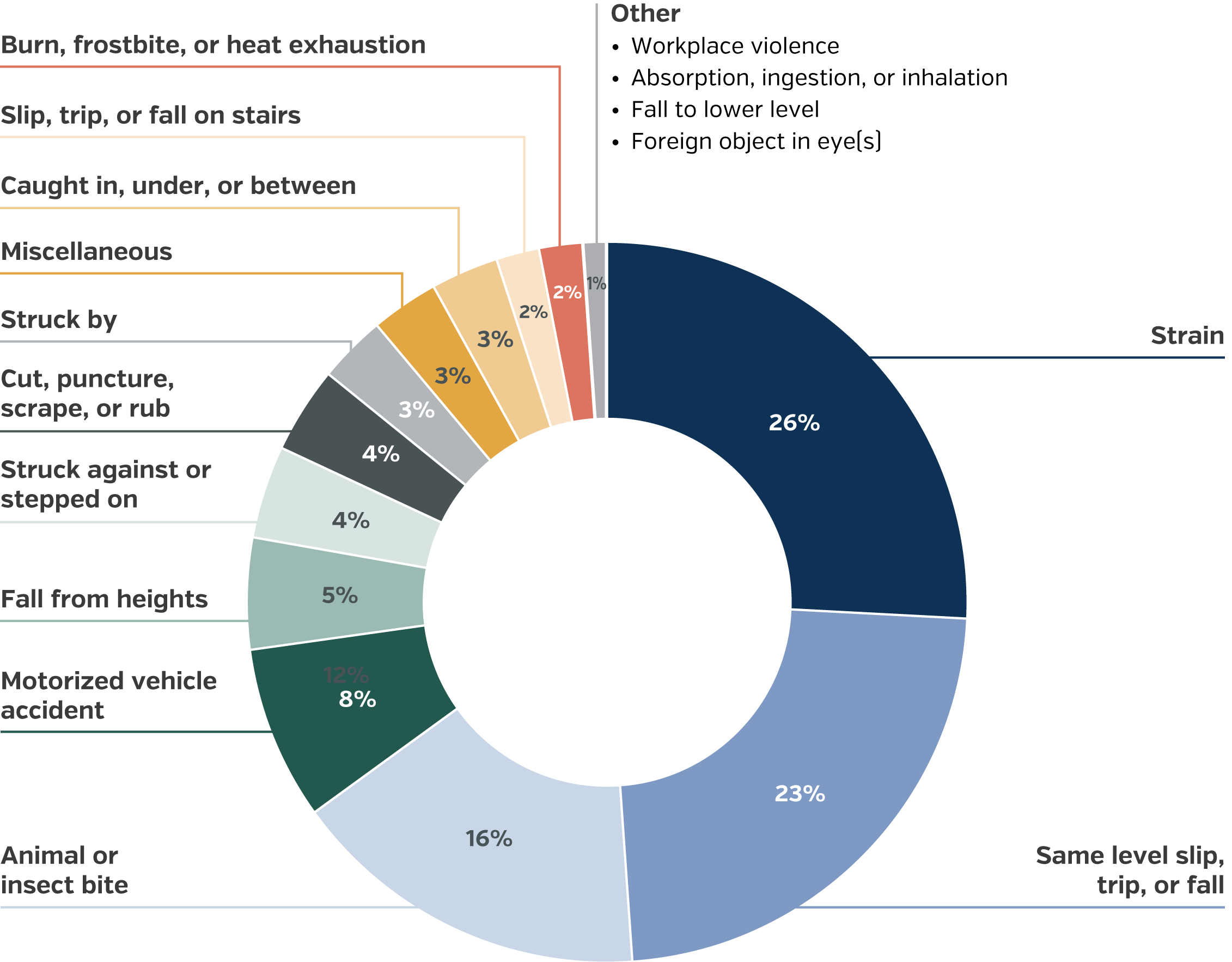
The five most reported delivery driver injuries based on lost-time and medical-only claims during 2022–2025 for Summit-managed insurers.1
- Strain: Involving lifting, twisting, pushing, or pulling of materials.
- Same level slip, trip, or fall: Involving inappropriate walking stride, slippery, or uneven walking surfaces.
- Animal or insect bite: Involving bite, sting, or allergic reaction.
- Motorized vehicle accident: Involving injuries while operating or being struck by a motor vehicle.
- Fall from heights: Involving falling from stairs, a landing or other elevated working area to a surface below.
Examining our latest delivery drivers injury data in more detail
Summit’s internal data shows that injuries among delivery drivers are on the rise. The most common body parts involved in these injuries are the ankle, knee, lower back, and lower leg. Employees can help reduce the risk of workplace injuries by taking a proactive safety approach.
Employers can also play a key role in mitigating risks by providing proper education on job‑specific hazards, conducting safety assessments, and providing corrective actions when needed.1
Injuries reported among delivery drivers
Based on lost-time and medical-only claims during 2022–2025 for Summit-managed insurers.1
Key safety measures that help delivery drivers avoid injuries
Preventing strains
- Stretch muscles prior to and after your shift.
- Size up the load before lifting. If it’s too heavy, get help or use a lift.
- As you bend down to lift, bend with your legs, not your back.
- Make sure your carrying path is clear with no obstacles to navigate around.
- Choose pushing movements over pulling movements, when possible, to avoid straining your lower back.
- Avoid twisting or leaning while you’re lifting or carrying an object.3
Preventing slips, trips, or falls
- Climb in and out of vehicles with at least three points of contact, moving one limb at a time.
- Take your time and pay attention to your surroundings; plan your delivery path before proceeding and use a flashlight or headlamp in low lighting.
- Adjust your stride to a pace that is suitable for the walking surface and the task at hand; check for uneven surfaces, such as broken bricks or concrete.
- Take short steps on slippery surfaces to keep your center of balance under you and point your feet slightly outward. Use walkways when available and never run.8
Preventing dog bites
- Communicate with homeowners about pets before entering a yard or home. Ask them to move animals inside or to a separate room of the house.
- Avoid startling a dog by making your presence known before you enter its territory by using a walking bell, whistling, honking your horn, or calling out to gauge their response.2
- Don’t assume dogs are friendly and can be safely approached. Pay close attention to a dog’s body language. Some signs of aggression are growling, barking, stiffness, baring teeth, yawning, and pulled back head and ears.7
- Carry dog repellent, mace, or loud air horn. Make sure you adhere to the guidelines of use set by your employer.5
Preventing motorized vehicle accidents
- Check vehicles before use to make sure they are in safe operating condition.
- Avoid distractions, such as cell phone use or eating, while driving.
- Obey the speed limit.
- Program your navigation system and familiarize yourself with your route before you begin driving.
- Avoid speeding and harsh braking.6
- Make wide turns at corners.4
Preventing falls from heights
- Climb in and out of vehicles with at least three points of contact, moving one limb at a time.
- Carry packages in a manner so that you have a clear view ahead.
- Hold handrails on stairs when available.
- Use a flashlight or headlamp when lighting is minimal.
- Check for any broken bricks or concrete on steps before proceeding.9
Did you know?
- According to the United States Postal Service (USPS), more than 6,000 postal employees were attacked by dogs in the United States in 2024. It’s important to remember that dogs are territorial in nature and protective of their owner’s property.2 Make sure all employees know how to report unsafe working conditions.
Summit’s safety team is here for you.

Safety consultants can assist in injury prevention by:
- Providing assistance and training for hazard identification, job safety analysis, and incident investigations
- Conducting site surveys
- Providing recommended solutions to improve safety
- Our employers and agents have access to an extensive library of online safety training videos and supplemental materials. Insureds and agents can request login credentials via email. provided through JER HR Group LLC, dba Training Network, a Summit vendor.)
Ensuring the safety of your workers is crucial for running an efficient and lucrative business.
Your employees are essential to your business’s productivity and success, so it makes sense that you invest in their health and well-being.
Summit is here to support you in that goal—not only by providing premier workers’ comp coverage—but also by offering resources to help educate you and your employees on safe work practices.
Contact Summit Loss Prevention at 1-800-282-7648.
Footnotes
- This information was obtained from insurers managed by Summit from 01/01/2022 to 12/31/2025
- “U.S. Postal Service Releases Dog Bite National Rankings,” United States Postal Service, May 29, 2025, https://about.usps.com/newsroom/national-releases/2025/0529-usps-releases-dog-bite-national-rankings.htm (Accessed Jun. 6, 2026).
- “Preventing Lower Back Injury in the Workplace,” OSHA.net, OSHA-Pros USA, LLC., April 20, 2015, www.osha.net/workplace-safety/safety-training-prevent-workplace-low-back-injury/ (Accessed Jun. 6, 2026).
- “Slips, Trips and Falls,” OSHA, www.osha.gov/sites/default/files/2018-12/fy16_sh-29672-sh6_SlipsTripsFallsHandoutforSafetyCommitteeMeetings.pdf (Accessed Jun. 6, 2026).
- “Be Alert: Prevent a BITE,” Postal Posts, United States Postal Service, June 11, 2021, uspsblog.com/dog-bite-prevention (Accessed Jun. 6, 2026).
- “Work-Related Roadway Crashes: Prevention Strategies for Employers,” U.S. Centers for Disease Control and Prevention, March 2004, https://stacks.cdc.gov/view/cdc/5754 (Accessed Jun. 6, 2026).
- “Dog Bite Prevention,” American Soc. For the Prevention of Cruelty to Animals (ASPCA), www.aspca.org/pet-care/dog-care/dog-bite-prevention (Accessed Jun. 6, 2026).
- “Hand and Power Tools,” U.S. Dept. of Labor, OSHA 3080, 2002 (Revised), http://www.osha.gov/sites/default/files/publications/osha3080.pdf (Accessed Jun. 6, 2026).
- “OSHA’s Fall Prevention Campaign,” U.S. Dept. of Labor, Occupational Safety and Health Administration, https://www.osha.gov/stop-falls (Accessed Jun. 6, 2026).
The information presented in this publication is intended to provide guidance and is not intended as a legal interpretation of any federal, state or local laws, rules or regulations applicable to your business. The loss prevention information provided is intended only to assist policyholders of Summit managed insurers in the management of potential loss producing conditions involving their premises and/or operations based on generally accepted safe practices. In providing such information, Summit Consulting LLC does not warrant that all potential hazards or conditions have been evaluated or can be controlled. It is not intended as an offer to write insurance for such conditions or exposures. The liability of Summit Consulting LLC and its managed insurers is limited to the terms, limits, and conditions of the insurance policies underwritten by any of them.