Our Latest Healthcare Safety Data
The healthcare industry employs more than 18 million workers in the U.S. and is projected to add about 2.4 million new jobs by 2029—more than any other occupational group. This projected growth is due to an aging population, which will lead to a greater demand for healthcare services.1,2
Let’s look at some of the more common injuries we’ve seen in healthcare and some recommended tips to help avoid them.
Top five reported injuries in healthcare
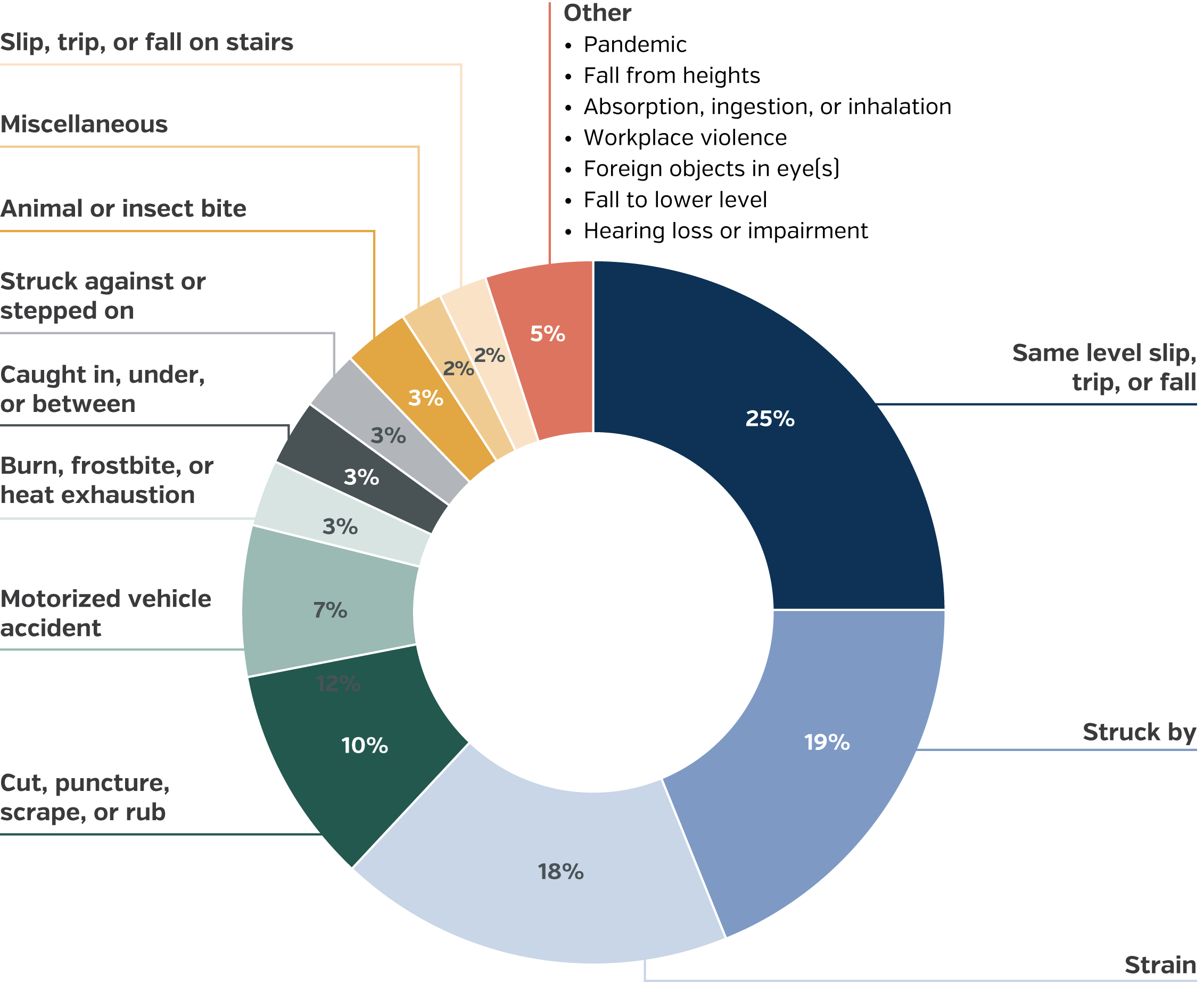
The five most reported injuries in healthcare based on lost-time and medical-only claims during 2022–2025 for Summit-managed insurers.3
- Same level slip, trip, or fall: Involving liquid spills on floors, uneven walking surfaces, cluttered floors, or not wearing slip resistant shoes.
- Strain: Involving improper lifting, pulling or pushing of a patient, or medical equipment.
- Struck by: Involving combative or agitated patients in nursing homes or youth social services facilities.
- Cut, puncture, scrape, or rub: Involving lack of personal protective equipment, needle sticks, improper use of medical devices or equipment, or animal bites during home visits.
- Motorized vehicle accident: Involving home injury type healthcare workers driving to and from patients’ homes.
Healthcare industry not immune to injuries
Summit’s internal data shows that injuries in the healthcare industry were 11.2% of the total claims reported from 2022 to 2025. The most common body parts involved in these injuries were the lower back, knee, fingers, and shoulder, due to strain, same level slip, trip, or fall, and being cut, punctured, or scraped by an object.3 Many of these injuries can be avoided with continual safety training and education.
Employers play a key role in mitigating risks by providing proper education on job-specific hazards, conducting safety assessments, and providing corrective actions when needed.
Injuries reported among healthcare employees
Key safety measures that help healthcare employees avoid injuries
Preventing same level slip, trip, or fall
- Ensure spills are reported and cleaned up immediately.
- Use waterproof footwear to decrease slip and fall hazards.
- Do not use stools, chairs or boxes as substitutes for ladders.
- Eliminate cluttered or obstructed work areas.
- Use flashlights or low-level lighting when entering patient rooms during night hours.5
- Wear proper nonslip footwear.
Preventing being struck
- Call for help immediately if a patient becomes physically combative.
- Arrange furniture and medical equipment so that room entrances and exits cannot be blocked by patients.
- Be alert for potential violence and suspicious behavior and report it.
- Establish a system to track and evaluate violent behaviors, including a way to communicate information from one shift to another.
- Ensure that the patient cot, floor mount and restraint system are in place while transporting a patient in an ambulance.7,8
Preventing strains
- Use safe patient handling techniques, including body mechanics for proper ergonomics.
- Never lift a fallen patient alone. Use team lifts or mechanical assistance.
- Avoid heavy lifting, especially with your spine rotated.
- Never transfer a patient when feeling off-balance.
- Lift loads close to the body using your legs, not your back.6
Preventing being cut, punctured, scraped, or rubbed by an object
- Do not bend, recap or remove contaminated needles and other sharps.
- Discard contaminated sharps immediately into appropriate containers.
- Sharps containers should be accessible, maintained upright and not overfilled.
- Do not pass sharps between workers.
- Use needles with engineered sharps injury prevention features.9
Preventing motorized vehicle accidents
- Set and enforce mandatory seatbelt use policies.
- Choose fleet vehicles with the highest possible levels of occupant protection in the event of a crash.
- Maintain records of workers’ driving performance.
- Incorporate training on fatigue management and the dangers of distracted driving into safety programs.
- Provide an emergency kit containing a flashlight, extra batteries, flares, a blanket and bottled water.10
Did you know?
- According to the Bureau of Labor Statistics, the likelihood of injury or illness resulting in days away from work is higher in hospitals than in construction and manufacturing—two industries that are relatively hazardous.2
• It’s important to focus on efforts to keep healthcare workers safe while at work so that they can continue to provide essential services.
Summit’s safety team is here for you.
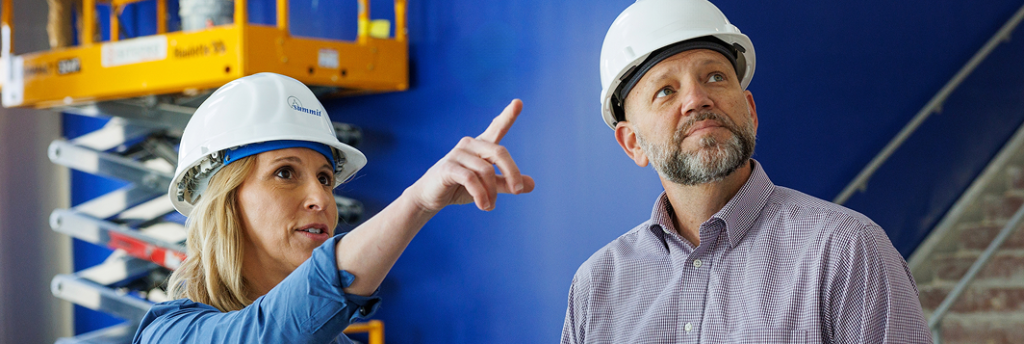
Safety consultants can assist in injury prevention by:
- Providing assistance and training for hazard identification, job safety analysis, and incident investigations
- Conducting site surveys
- Providing recommended solutions to improve safety
- Our employers and agents have access to an extensive library of online safety training videos and supplemental materials. Insureds and agents can request login credentials via email. (Videos provided through JER HR Group LLC, dba Training Network, a Summit vendor.)
Ensuring the safety of your workers is crucial for providing efficient healthcare services.
Your employees are essential to your business’s productivity and success, so it makes sense that you invest in their health and well-being.
Summit is here to support you in that goal—not only by providing premier workers’ comp coverage—but also by offering resources to help educate you and your employees on safe work practices.
Contact Summit Loss Prevention at 1-800-282-7648.
Footnotes
- “Healthcare Workers,” Centers for Disease Control and Prevention, https://www.cdc.gov/niosh/healthcare/?CDC_AAref_Val=https://www.cdc.gov/niosh/topics/healthcare/default.html (Accessed Jun. 6, 2026).
- “Healthcare Occupations,” U.S. Bureau of Labor Statistics, August 28, 2025, www.bls.gov/ooh/healthcare/home.htm (Accessed Jun. 6, 2026).
- This information was obtained from insurers managed by Summit from 01/01/2022 to 12/31/2025.
- “Worker Safety in Hospitals: Caring for our Caregivers,” Occupational Safety and Health Administration, U.S. Department of Labor, www.osha.gov/hospitals/understanding-problem (Accessed Jun. 6, 2026).
- “Hospital-wide Hazards: Slips, Trips and Falls,” Occupational Safety and Health Administration, https://www.osha.gov/etools/hospitals/hospital-wide-hazards/slips-trips-falls (Accessed Jun. 6, 2026).
- “Hospital-wide Hazards: Work-related Musculoskeletal Disorders,” Occupational Safety and Health Administration, U.S. Department of Labor. https://www.osha.gov/etools/hospitals/hospital-wide-hazards/work-related-musculoskeletal-disorders (Accessed Jun. 6, 2026).
- “Hospital-wide Hazards: Workplace Violence,” Occupational Safety and Health Administration, U.S. Department of Labor, https://www.osha.gov/etools/hospitals/hospital-wide-hazards/workplace-violence (Accessed Jun. 6, 2026).
- “4 quick ways to improve ambulance safety,” EMS1, Lexipol, Sep. 2, 2019, https://www.ems1.com/patient-safety/articles/4-quick-ways-to-improve-ambulance-safety-pGJYqy8RC9FAIWlA (Accessed Jun. 6, 2026).
- “Bloodborne Pathogens and Needlestick Prevention,” Occupational Safety and Health Administration, U.S. Department of Labor, www.osha.gov/bloodborne-pathogens/general (Accessed Jun. 6, 2026).
- “Home Healthcare Workers. How to Prevent Driving-Related Injuries,” Centers for Disease Control and Protection, NIOSH, Feb. 2012, http://www.cdc.gov/niosh/docs/2012-122/pdfs/2012-122.pdf (Accessed Jun. 6, 2026).
The information presented in this publication is intended to provide guidance and is not intended as a legal interpretation of any federal, state or local laws, rules or regulations applicable to your business. The loss prevention information provided is intended only to assist policyholders of Summit managed insurers in the management of potential loss producing conditions involving their premises and/or operations based on generally accepted safe practices. In providing such information, Summit Consulting LLC does not warrant that all potential hazards or conditions have been evaluated or can be controlled. It is not intended as an offer to write insurance for such conditions or exposures. The liability of Summit Consulting LLC and its managed insurers is limited to the terms, limits, and conditions of the insurance policies underwritten by any of them.